
The Secret to Lighting Highly Reflective Art: Avoiding the “Mirror Effect”
Displaying art with a high-shine finish—think glossy oils, glossy photographs or glass-encased art, presents a unique challenge. These surfaces don’t just show off color and texture; they act like mirrors. If your lighting isn’t precise, your viewers might end up staring at a glare or a bright light bulb instead of your masterpiece.
The Problem: Eye-Level Glare
When highly reflective art is hung above eye level, it becomes a prime candidate for unwanted reflections and can cause light to scatter. If a light source is placed directly in front of the piece, the glossy surface bounces that light straight back into the viewer’s eyes.
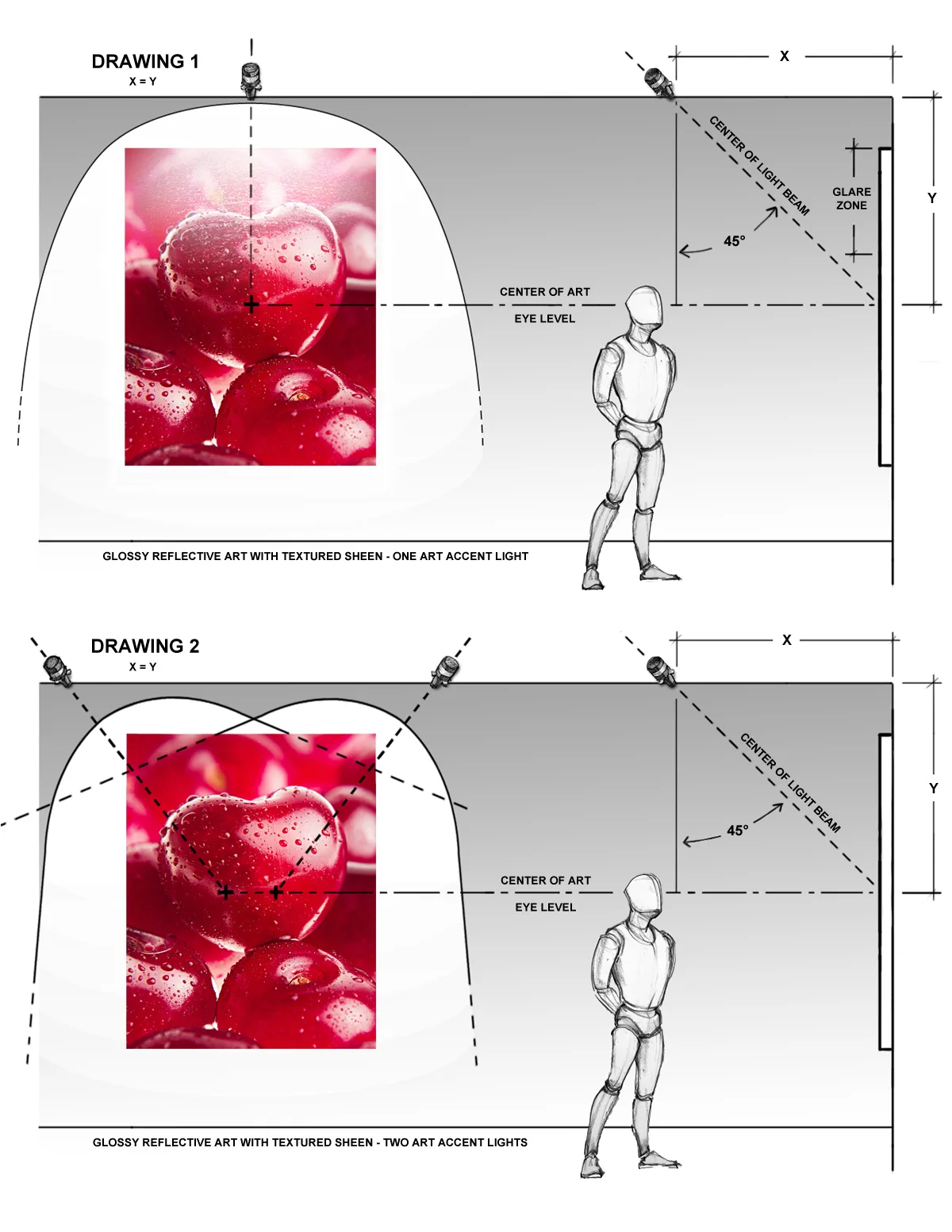
In this scenario, a distracting “hot spot” or light source reflection usually appears along the upper portion of the artwork (Illustrated in Drawing 1). While this reflection might disappear if you move to the far side of the room, anyone viewing the art from a standard, forward position will have their view obscured by glare.
The Solution: The “Offset” Technique
To eliminate glare for a viewer looking straight at the glossy art hung above eye level, you have to change the math of the light’s path. Instead of one central light, try using two art lights positioned beyond the outer edges of the frame (Illustrated in Drawing 2).
By offsetting the lights, you manipulate where the reflection lands:
From the Front: The “angle of incidence” is pushed outward, meaning the glare misses the viewer’s eyes entirely. The art looks legible and vibrant.
From the Sides: While the reflection may become visible if someone walks to the extreme left or right, the primary viewing experience remains flawless.